
Selling a medical device in both the US and EU means satisfying two different regulatory systems, each with its own classification rules, oversight bodies, and documentation requirements. For OEMs working with a contract manufacturer, understanding where these requirements overlap and where they differ is the first step in figuring out whether one manufacturing partner can support both markets or whether you need separate relationships for each.
In this article, we'll break down how FDA and EU MDR compare, what has recently changed, and what to look for in a manufacturing partner that can support compliance in both markets.
The FDA regulates US medical devices through a classification and clearance system, using pathways like 510(k) or PMA depending on device risk. EU MDR (Regulation 2017/745) takes a broader life-cycle approach, requiring ongoing clinical evidence and post-market follow-up throughout a device's time on the market.
Since the FDA's 2026 shift to the Quality Management System Regulation (QMSR), both systems now share ISO 13485:2016 as a quality baseline for higher-risk devices, which is a meaningful point of convergence between two frameworks that used to run on separate tracks.
FDA vs. EU MDR at a glance:
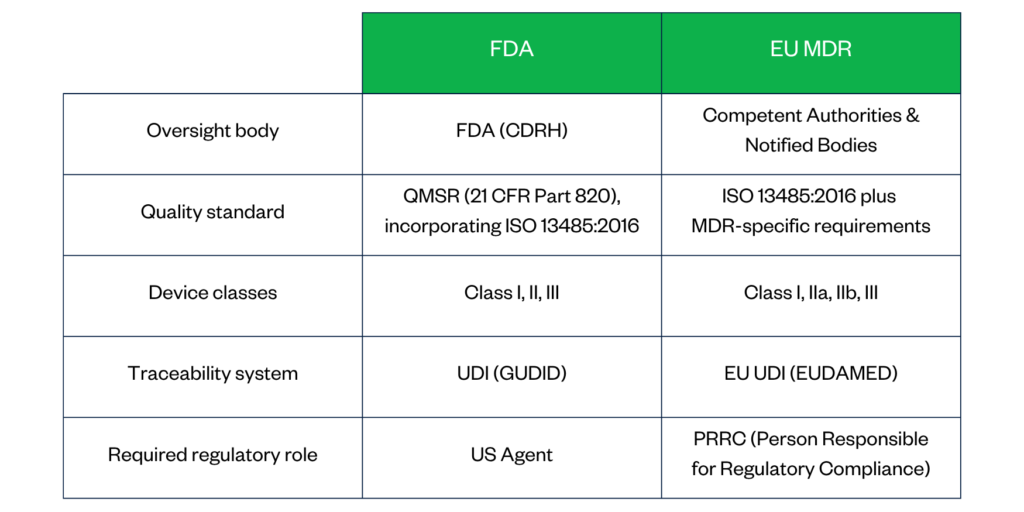
The FDA's Quality Management System Regulation (QMSR), effective February 2, 2026, eliminates the need for contract manufacturers to maintain separate quality documentation systems for the US and EU markets. By replacing the old 21 CFR Part 820 framework with a standard built directly on ISO 13485, the same standard EU MDR already relies on, the FDA closed most of the gap between the two systems.
Before this change, a manufacturer selling into both markets often had to run two parallel quality systems, each with its own documentation style and audit expectations. That overlap matters most for OEMs actively vetting manufacturing partners. A contract manufacturer that built its quality system around ISO 13485 before the QMSR took effect likely has a head start, while one that only ever tracked the old QSR requirements has more catching up to do.
A contract manufacturer's responsibilities under EU MDR depend on how it's formally classified within the supply chain. MDR requires every party involved, whether manufacturer, distributor, importer, or authorized representative, to take on a defined role with its own set of obligations.
For most contract manufacturers, that role comes with four core responsibilities:
Higher-risk medical devices, Class IIa, IIb, and III, generally require ISO 13485 certification in both the US and EU. Lower-risk Class I devices can often self-certify without it.
The FDA doesn't formally mandate certification the way EU MDR effectively does through Notified Body requirements. But since the QMSR now builds directly on ISO 13485, a manufacturer without that certification is at a real disadvantage demonstrating compliance, even without a formal requirement to hold one.
Rather than checking for a certificate, the FDA conducts its own QMSR-based inspections, evaluating a manufacturer's actual quality system against the standard rather than confirming paperwork.
For OEMs, that certification is a reliable signal that a manufacturer is already prepared for the scrutiny both markets require.
Yes. A single contract manufacturer with the right certifications can support both FDA and EU MDR compliance, since ISO 13485 now serves as a shared quality standard across both frameworks for higher-risk devices.
Consolidating under one manufacturer, rather than splitting production across separate US and EU partners, comes with several practical advantages:
Kingstec has built its manufacturing relationships around exactly this kind of dual-market readiness, with the regulatory experience to support OEMs navigating FDA and EU MDR requirements without splitting production across multiple partners.
Use these questions to evaluate whether a manufacturer's compliance practices hold up under real scrutiny, not just on paper.
Kingstec is an all-in-one engineering, manufacturing, project management, and logistics partner with over 43+ years of experience. We can help you:
Contact Kingstec for a free consultation.