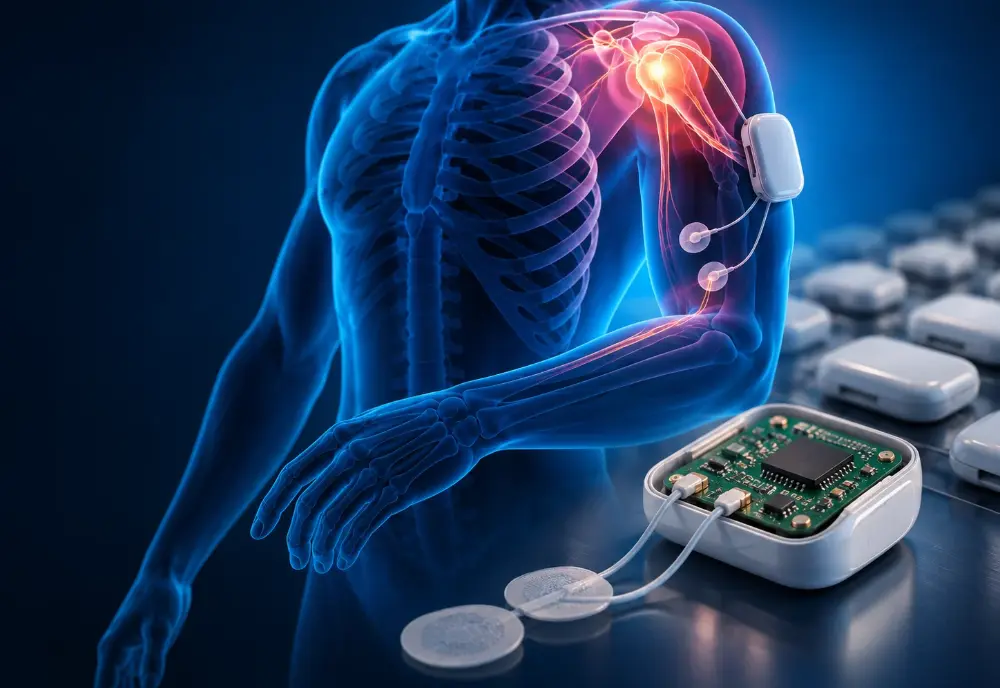
Chronic disease is on the rise, now accounting for 64.5% of deaths worldwide, and both physicians and patients are looking for alternatives to a lifetime of medication. Bioelectronic medicine, which uses electrical stimulation instead of drugs to treat chronic conditions, is answering that demand, moving out of research labs and into real clinical practice. That shift shows up in the numbers: one report projects the global neuromodulation market will grow from roughly $6.8 billion in 2025 to $10.7 billion by 2030.
For companies developing bioelectronic devices, this growth creates an opportunity to move promising technologies into a larger patient population. But commercializing a device takes more than proving that the technology works. It also means manufacturing thousands of consistent, medical-grade devices while meeting the quality and regulatory requirements that come with scale. The companies best positioned to capture that opportunity are the ones that treat manufacturing as part of the strategy from the start, not something to solve once demand arrives.
Here's what to prioritize when moving a bioelectronic device from prototype to production.
A prototype can prove that a device works, but it doesn't necessarily prove that the design is ready for production. Features that work on a 3D-printed part can create problems when that same part needs to be injection molded thousands of times. Threads, undercuts, wall thicknesses, draft angles, and other details all need to be considered with repeatable production in mind.
Wilson Chiu, President of Kingstec, says this is one of the most common issues he sees when products move from prototype to production. “It's an easy gap to miss. A part can 3D print perfectly, and everything looks right on the prototype. But injection molding has its own rules, and some features that print without a problem just can't be molded. When we can look at a part early, we can usually catch those issues before they turn into delays or costly mold changes. That's why it pays to talk to a manufacturer who understands injection molding before the part is locked in."
That's why a design for manufacturability (DFM) review should happen before a device moves into tooling, not after. Bringing a manufacturing partner in at this stage means potential production issues get caught while they're still easy to fix, rather than after tooling has already been built around a design that won't work at scale. It confirms whether the design can be produced consistently, and if it can't, what needs to change.
A bioelectronic device rarely consists of one type of component. Depending on the application, the finished product may combine custom cables, wearable components, PCBAs, injection-molded plastics, and other specialized parts, each with its own manufacturing requirements.
Working with separate suppliers for each component adds complexity as production scales. A change to one part can affect fit or function elsewhere, requiring multiple vendors to coordinate around the same issue at once.
Kingstec's turnkey box-build work for Technology Trace Inc.'s trevii® medical asset tracking devices shows what the alternative looks like. Technology Trace relies on Kingstec for both the plastic enclosures and PCBAs, rather than coordinating those components across separate manufacturers, and works with one team across the manufacturing process instead of managing several.
That single-partner approach provides:
As a device moves from development into higher-volume production, that kind of consolidation can be the difference between a smooth transition and a stalled one.
Medical device manufacturing comes with a level of quality and regulatory oversight that most other industries don't face. Every step of the process needs to be documented, verified, and validated, and that standard doesn't loosen as production scales up.
John Long, VP of Operations at SetPoint Medical, described the challenge directly in a recent Kingstec case study: “One of the biggest challenges in medical device manufacturing is the amount of regulatory and quality control across all aspects of development. Every step of the manufacturing process has to be verified and validated based on stringent regulations and standards. To manage that, you need to have really high engagement with your contract manufacturers, which, as you can imagine, can be difficult when you are a small company.”
That's why any prospective manufacturing partner needs to match that level of engagement, not just in producing the physical device, but in the quality systems and regulatory experience built into the relationship itself.
Kingstec has supported clients through both FDA and EU MDR requirements, including accompanying and managing the Notified Body audit process on their behalf. For a device maker navigating those requirements for the first time, having a manufacturing partner who already knows the process removes one of the biggest sources of risk in bringing a medical device to market.
A quality system that works for a handful of prototypes has to stand up to far more scrutiny once production reaches thousands of devices. As volume increases, so does the need for documentation and processes that show every unit is being produced to the same validated standards, including:
The real challenge is keeping that level of control as the product evolves. A change to a component, process, or specification has to be reflected in the right documentation immediately, or gaps start opening up in the quality record exactly where compliance depends on there being none.
Manufacturing relationships become more valuable the longer they run. As a medical device evolves, volumes shift and new regulatory requirements emerge, and a partner who already understands the product and its manufacturing history can adapt with it instead of starting from scratch.
"We have clients we've been working with for 20 years,” Chiu says, explaining that this relationship allows them to stay ahead of the game and know what to look out for. “We'll get warnings from our suppliers, usually a couple months out, that the indications aren't good for material costs or labor inflation, and we can go to those clients and say, don't let this slip by, lock in your order now."
That kind of advance notice only comes from a relationship built over years. For companies in a fast-moving field like bioelectronic medicine, that same continuity applies to more than cost. A manufacturing partner who has stayed with a product long enough to see problems coming is also positioned to adapt as the device, its components, and its regulatory requirements change over time.
With over 43 years of manufacturing experience, Kingstec helps bioelectronic device companies move from prototype to production without the delays that come from treating manufacturing as an afterthought.
Kingstec can help you:
Contact Kingstec to talk through what it takes to get your bioelectronic device from prototype to production.