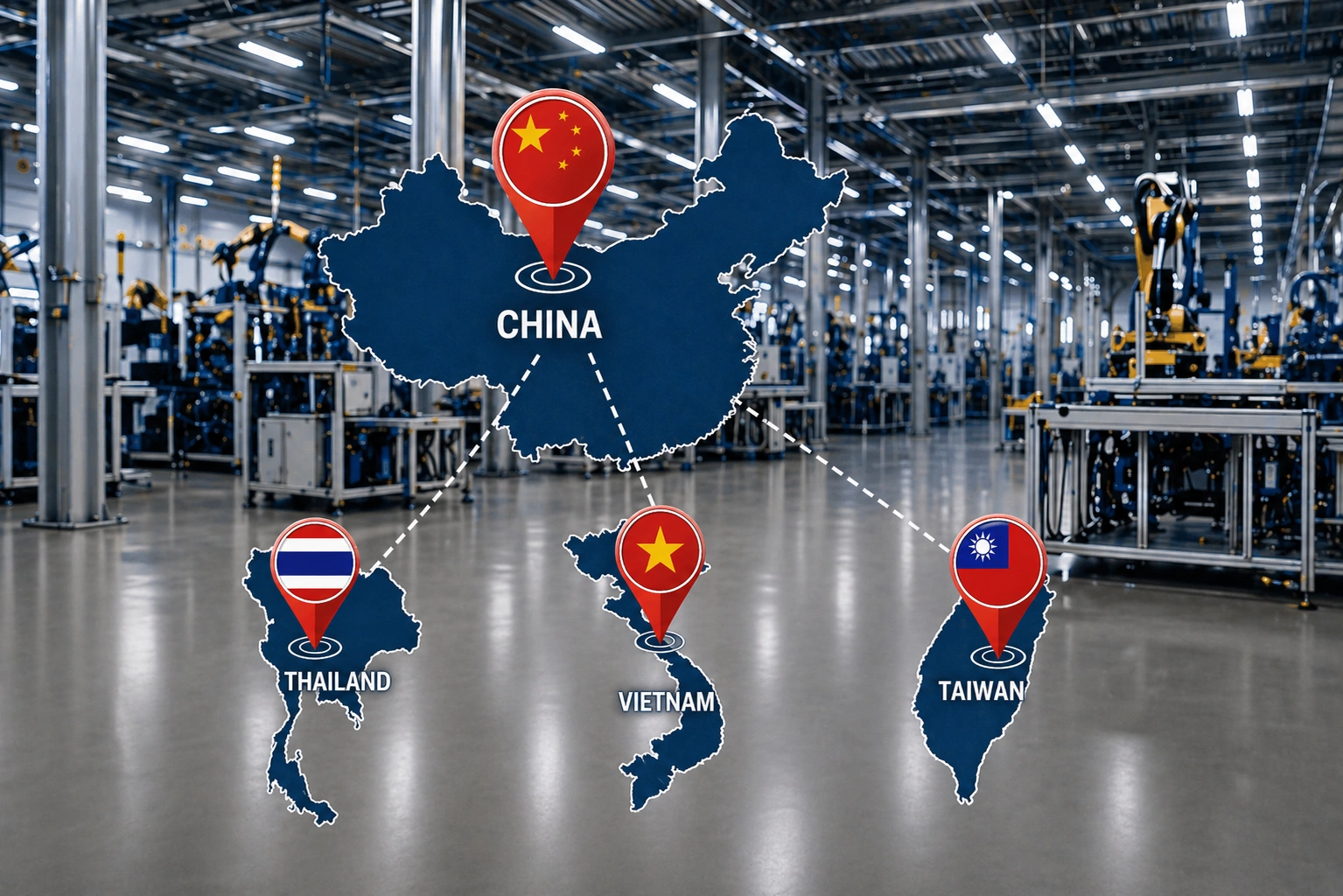
China's engineering depth, integrated supply chains, and technical expertise remain unmatched. But with continued tariffs and trade policy shifting faster than most companies can plan around, depending on China as your sole production source can be a liability.
That's where China Plus One comes in. This strategy gives manufacturers a way to preserve China's advantages while building resilience, reducing tariff exposure, and giving your supply chain room to breathe.
In this article, we'll look at how China Plus One works, which regions are emerging as the strongest secondary options, and how to best implement the strategy.
China Plus One is a supply chain diversification strategy in which a company keeps production in China while adding at least one other manufacturing location in another country.
Also referred to as China+1 (or C+1), the strategy is to reduce dependence on China, lower risk from tariffs, policy changes, and supply disruptions, and build resilience.
No. China Plus One is built around retaining China's core strengths while moving volume production or final assembly to a second location. What that means is that engineering, development, and supplier relationships can stay anchored in China. What changes is where the product gets made at scale.
One of Kingstec's partners, a contract manufacturer with deep roots in Shenzhen, is a good example of how this works. The company had been exploring alternative production locations since the first round of US-China tariffs but struggled to find a facility that met their quality standards. They ultimately established a Vietnam operation, renovating an existing facility for the fastest possible startup, hiring local management and workers, and sending their Shenzhen team to Vietnam regularly to transfer processes and ramp up production. Rather than building something new from the ground up, they extended what already existed in China into a second location, bringing the same standards, systems, and institutional knowledge with them.
That continuity is the key differentiator between China Plus One and full relocation. Quality, process, and relationships carry over. The supply chain becomes more flexible without becoming unfamiliar.
In short: tariffs. Tariffs on Chinese goods currently average 30 to 34%, with certain product categories reaching 55% under stacked penalties.
For many manufacturers, that alone has been enough to reassess sourcing and production strategies. But the pressure to diversify runs deeper, including:
Unsurprisingly, China’s share of the overall U.S. import market fell to 9 percent in 2025, which is the lowest it’s been since the early 2000s.
The manufacturers best positioned right now started diversifying before they had to. Proactive planning creates the time needed to qualify facilities, test production, and build supplier relationships on stable terms.
Vietnam is currently the most widely adopted secondary manufacturing destination, but the right choice depends on your product type, volume, and regulatory requirements.
It’s worth mentioning that a “plus one” also doesn't have to mean a single country. Many manufacturers use a tiered regional approach, sourcing components from one location and handling assembly in another, to optimize across cost, capability, and compliance.
Whichever region you choose, qualifying for that country's origin status requires substantial transformation of the product, not just final assembly or repackaging. Vietnam, for example, is in the process of formalizing a 30% local content threshold, and manufacturers that push the boundaries of what qualifies risk customs disputes and penalties. For a detailed breakdown of how origin rules work in practice, see our guide to navigating today's tariff landscape.
Here's how the leading Asian options compare:
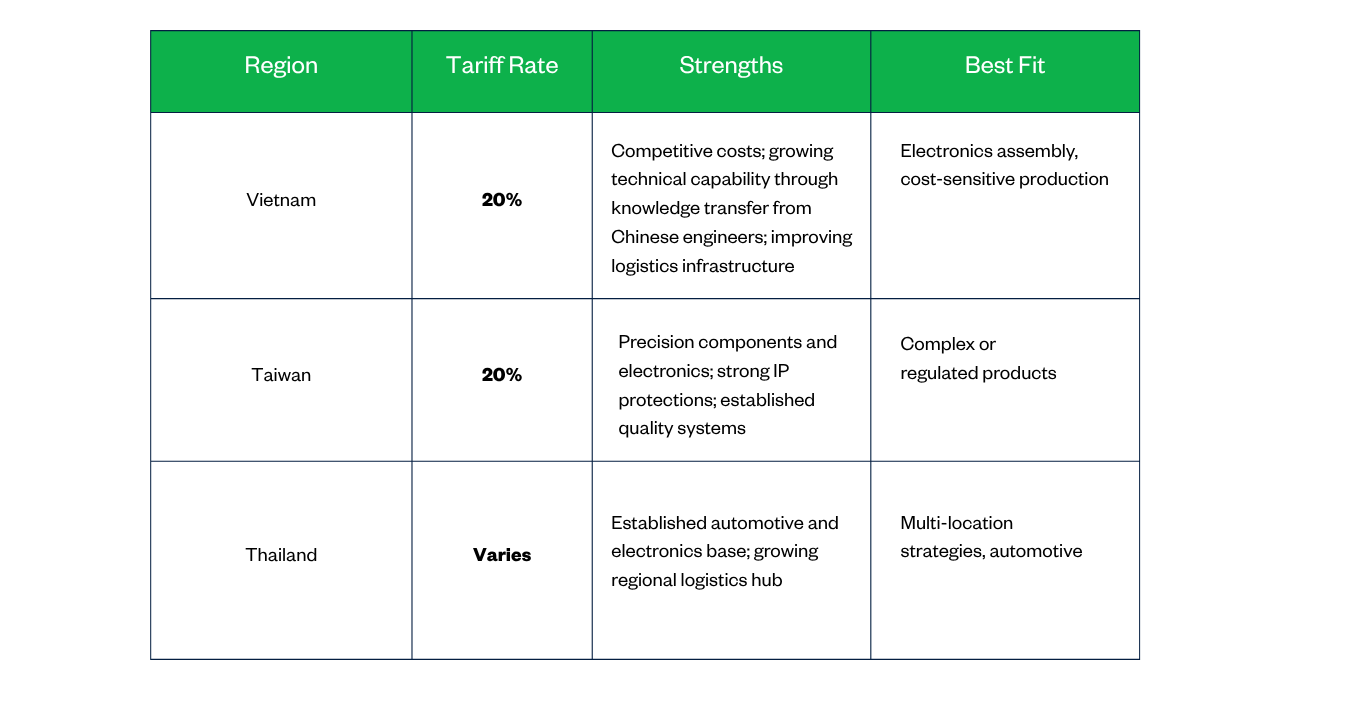 One practical note on Vietnam: while it shares a border with China, sea transport is typically more practical given the country's geography, and improving port infrastructure in Hai Phong and Ho Chi Minh City is making that a more efficient option.
In our experience, the manufacturers handling this transition best are taking a phased approach, qualifying the secondary facility before they need it rather than moving under pressure. Going too fast tends to create quality and logistics problems that are hard to unwind.
In practice, that looks like four steps:
Throughout the process, keep your primary China relationships intact. The objective is parallel capability, not replacement, and working with an experienced partner like Kingstec, with pre-vetted relationships across Asia, can significantly compress the time it takes to get there.
With 43 years of manufacturing relationships across China, Vietnam, Taiwan, and other Asian markets, Kingstec has the regional expertise and pre-vetted partner network to help you build a secondary manufacturing capability without disrupting what's already working.
Contact us today to discuss a component-level assessment of your current sourcing strategy.