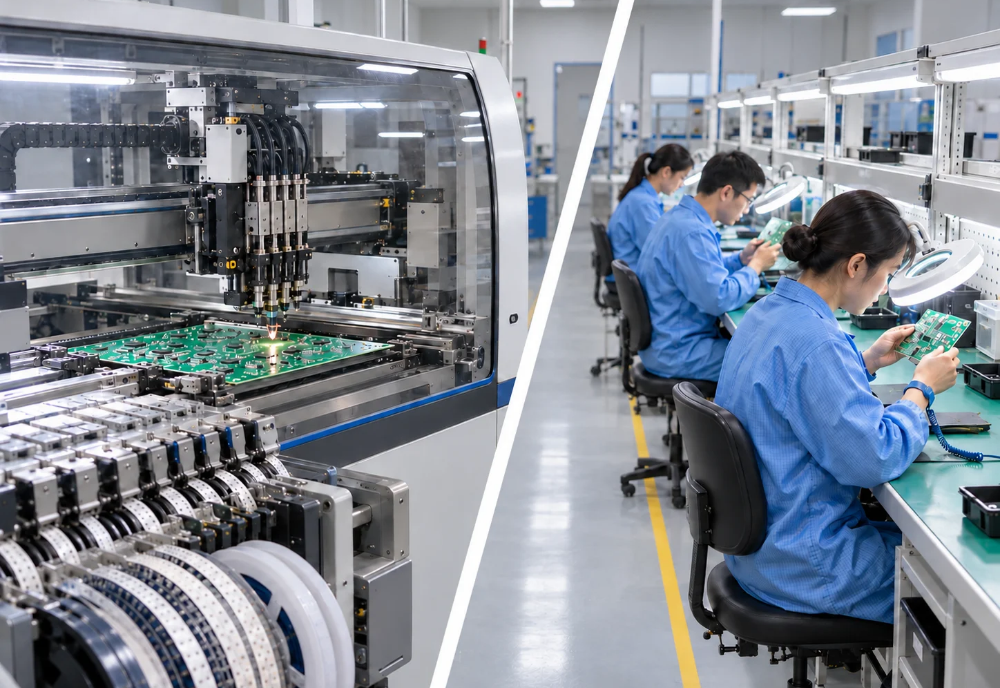
Factories installed a record number of industrial robots in 2025, bringing the global total past 5 million. Much of that growth is in Asia, where Vietnam added about 27% more robots last year and Taiwan ranks among the 10 most automated manufacturing economies in the world.
Despite this, people remain at the center of production, with workers still expected to do more than 81% of the work in manufacturing. For companies that outsource production, how a factory balances automation and skilled workers can change the economics of making a product. The right balance can improve consistency and increase output, while the wrong setup can add unnecessary costs or make production less flexible.
Let’s take a closer look at what automation is changing in contract manufacturing, how AI is driving up the cost of electronic parts, and what it all means for choosing a manufacturing partner.
AI and automation are changing how electronics are assembled, inspected, and tracked, but the benefits depend on production volume and complexity. High-volume orders can take advantage of automated production lines, while smaller or specialized runs often require more hands-on work.
For high-volume production, automated lines can:
Smaller production runs are a different story. Prototype builds, first production runs, and cable assembly often depend more heavily on skilled workers. Inspection is part of the reason: automated systems improve as they process more boards and learn what defects look like, so when volumes are low, there often isn’t enough data to rely on them alone. In those cases, technicians still inspect many boards by hand.
That said, some newer equipment is built with these smaller jobs in mind. Prototyping machines, for example, can now apply solder paste directly to a PCB and place components without the custom stencil that traditional solder paste printing requires, which reduces setup time and helps new products reach testing sooner.
The AI boom is putting pressure on the supply of electronic components, driving up costs for manufacturers across the electronics industry. Memory chip prices, for example, are expected to rise more than 400% between early 2024 and the end of 2026. Prices nearly doubled in the first three months of 2026, and some older memory chips are being discontinued as suppliers shift production toward newer, higher-demand products.
For companies making electronic products, that can mean higher component costs, fewer sourcing options, and product changes when parts become unavailable.
Copper is another pressure point. AI data centers require extensive power and networking infrastructure, adding to growing global copper demand and a projected supply shortfall. Because copper is used in cables, wiring, and circuit boards, rising demand can push up costs for electronic assemblies well beyond the data center industry.
Staying ahead of these cost pressures means paying closer attention to the parts that go into your product. The earlier you review your parts list, or bill of materials (BOM), the more options you’ll have if a component becomes expensive or hard to find. Three steps can help:
If you outsource production, look for a manufacturing partner that plans for these pressures. A partner that tracks supply risks, finds alternative parts, and buys components ahead of shortages can help you avoid unexpected costs and delays.
To choose the right contract manufacturer, compare what each factory can do against what your product needs, from production volume and quality requirements to regulatory obligations. Asking direct questions about automation, inspection, records, and parts supply is the quickest way to see whether a partner is a good fit.
Start with these five questions:
Automation varies from factory to factory and even from one product to the next. Ask which steps are automated, where technicians take over, and whether the equipment is set up for products like yours.
A factory with highly automated, high-volume lines may struggle with frequent product changes or specialized assembly work, so it’s worth knowing how your product will actually move through production.
Automated inspection works best at high volumes, so smaller runs often need more hands-on checks. Ask who inspects prototypes and early production builds, how defects are identified, and what happens when a problem is found. A clear quality process should be in place from the first units, well before production reaches full volume.
Ask what documentation you’ll receive, from inspection results and test reports to component lot numbers and production records. Detailed records make it easier to investigate defects, identify affected batches, and trace problems to their source.
A basic certificate may confirm that requirements were met, but it often won’t show what happened during production.
When parts become scarce or expensive, a manufacturer’s planning can make the difference between a minor adjustment and a delayed order. Ask how the factory monitors supply risks, qualifies alternative components, and plans purchases for parts that are hard to get.
It’s also worth confirming whether substitutes require your approval and how the manufacturer will let you know about a shortage that could affect your costs or delivery schedule.
Medical device manufacturing requires documented quality processes that can withstand regulatory scrutiny, and that includes the automated systems used for inspection and tracking. Ask how the factory validates this software, how its quality management system supports FDA requirements and relevant ISO standards, and how it maintains records for audits.
This has become especially important in 2026. The FDA’s Quality Management System Regulation (QMSR), which took effect on February 2, now builds directly on ISO 13485:2016 and applies to contract manufacturers as well as device makers. Our article on FDA vs. EU MDR compliance explains what the change means in practice and what else to ask a potential partner.
Kingstec is an all-in-one engineering, manufacturing, project management, and logistics partner with over 43 years of experience. We can help you:
Contact Kingstec for a free consultation.