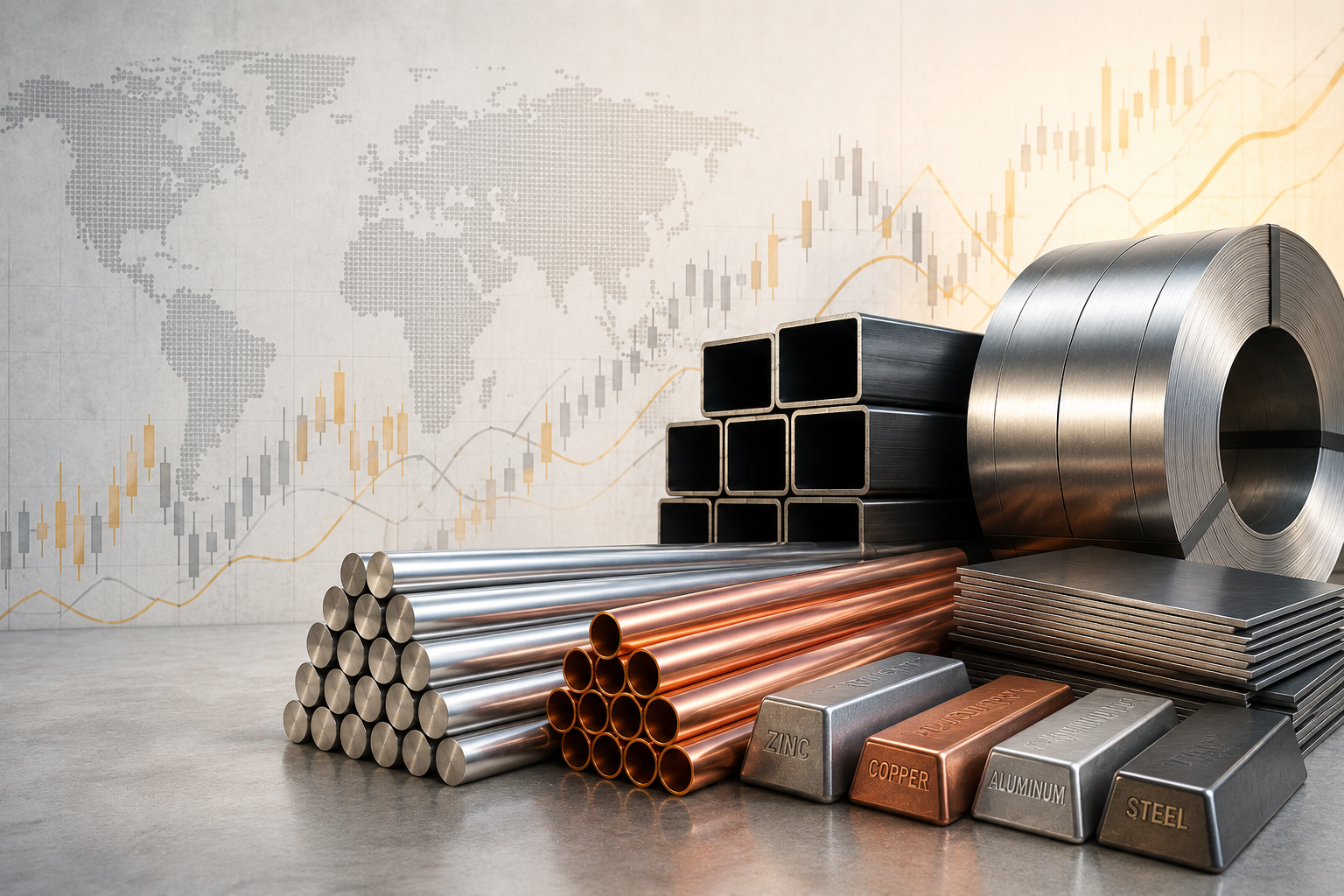
Metal costs are climbing, and manufacturers are feeling the pinch. Copper, gold, and steel prices have all increased significantly over the past year, squeezing margins on everything from wire harnesses to stamped enclosures. For companies that rely on contract manufacturing in Asia and beyond, these increases often arrive with little warning, bundled into supplier price updates that leave little room to negotiate.
The challenge is that most manufacturers don’t track commodity prices until costs have already moved through the supply chain. By the time a price increase lands on your desk, you’ve often lost the opportunity to lock in better rates or adjust your designs.
In this article, we'll look at what's driving metal prices up, which components carry the most exposure, and four strategies to protect your manufacturing costs before the next increase hits.
Several forces are pushing metal prices higher at the same time. Gold often sets the pace for broader commodity markets, and when gold spikes, industrial metals tend to follow. Inflation is compounding the pressure. Labour costs are rising, particularly in China, where a tightening workforce (partly a legacy of the one-child policy) has made it harder for factories to attract workers.
Energy prices are climbing too, hitting metal production especially hard. Aluminum smelting requires so much electricity that much of North American production has shifted to regions with abundant hydroelectric power, like Quebec.
The result is a cascading effect: higher energy costs increase extraction costs, which raise raw material prices, which push up component costs, which squeeze your margins.
Gold, copper, and steel are the three metals hitting manufacturing costs hardest right now. Gold is leading the surge, with prices climbing 50–65% through 2025 as investors continue to seek out safe-haven assets amid economic uncertainty.
The price of copper is climbing for different reasons. Strong demand from electronics, electric vehicles, and infrastructure projects is running up against supply constraints. For manufacturers building wire harnesses or PCBAs, copper is often the single largest material cost driver, representing between 30-50% of raw material costs.
Steel prices are rising more gradually, pushed by energy and labor costs across production. If your products include stamped enclosures, brackets, or structural housings, you're likely already seeing the impact in supplier quotes.
How much this affects you depends on what you're building. These components typically carry the highest metal cost exposure:
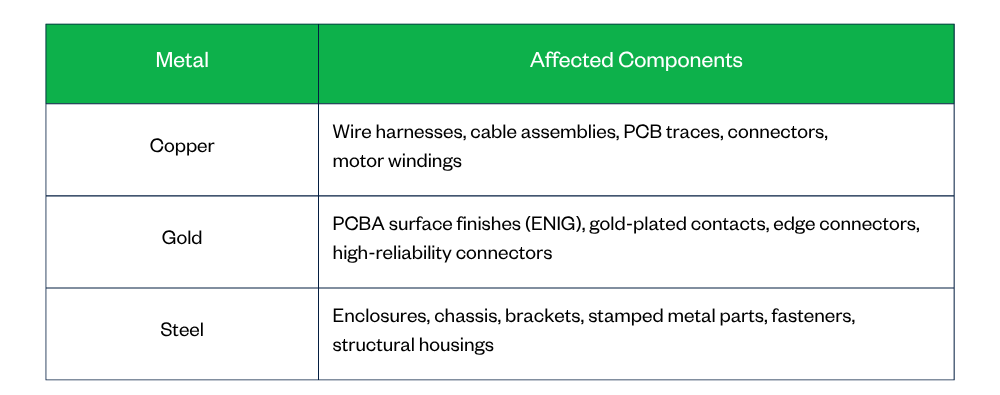
Plastics-heavy products feel oil price swings more than metal volatility. But if your product includes electronics, wiring, or metal housings, you have exposure worth evaluating.
Metal price exposure is manageable if you plan ahead. Here are four strategies that can help protect your margins:
Assess your metal exposure
Start by analyzing the metal content of each product in your lineup. This sounds obvious, but most manufacturers don't have a clear picture of which products carry the most material cost risk until a price increase forces the question.
Review your demand forecast for the coming year and map it against your metal-heavy components. This is fundamentally a forecasting exercise: calculate your metal content per product, multiply it by projected volumes, and identify where your biggest exposure sits. Running this analysis before prices spike gives you options you won't have later.
Lock in pricing early
Suppliers typically signal price increases around November or December, ahead of the new year. If you can commit to volume before those increases take effect, you can often lock in current pricing for the year.
The key is using historical order data to set a realistic commitment level. One long-term Kingstec client, for example, had been ordering roughly $1.6 million in components annually for over 20 years. When suppliers signaled increases, we advised them to lock in $1.3 million at current rates and absorb the variance on the remaining $300,000. That approach protected most of their annual spend while still leaving room for demand fluctuations.
Timing matters too. In our experience, minimum wage increases in China often take effect after Chinese New Year, which can push labour costs up significantly. Locking in pricing before that window closes matters.
Consider alternative materials
Not every application requires premium materials. Evaluating alternatives can reduce costs without sacrificing performance.
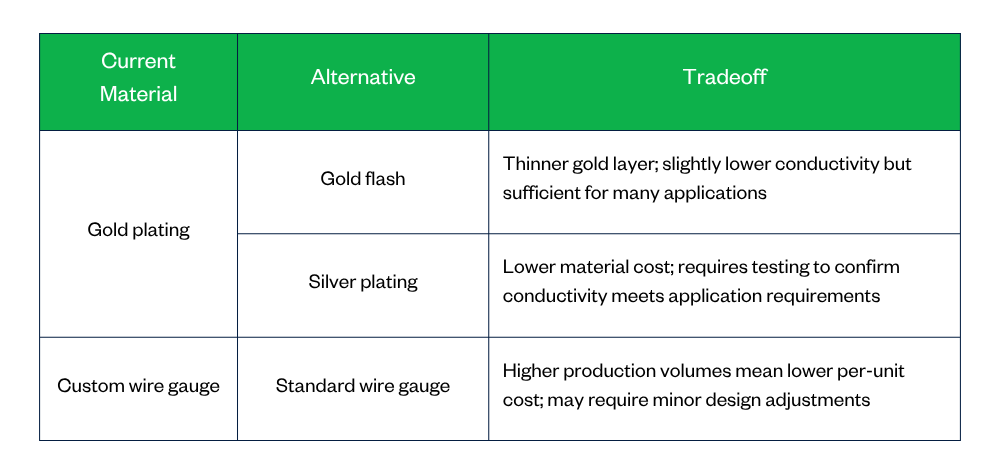
These decisions require testing and validation, but they're worth exploring, especially for high-volume products where small per-unit savings add up quickly.
Design with material cost in mind
Material costs are easier to control when you build them into the design process early. Standard wire gauges, for example, cost less than custom sizes simply because manufacturers produce them in far higher volumes. Custom gauges typically carry both higher per-unit costs and longer lead times.
The same principle applies to plating and surface finishes. If your design calls for gold plating by default, it's worth asking whether that spec is driven by actual performance requirements or inherited assumptions from an earlier version of the product.
Building this review into your design for manufacturing process helps catch over-engineering before it becomes locked into production.
Kingstec is an engineering, manufacturing, and logistics partner with over 43 years of experience producing high-quality components across Asia.
We can help you:
Contact Kingstec for a free consultation without sacrificing performance.